Showing posts with label Nonshort Reviews. Show all posts

13/02/2010

1928: La passion de Jeanne d'Arc (The Passion of Joan of Arc)

If you like courtroom dramas but are looking for one that's somewhat different, try The Passion of Joan of Arc. It even has a plot twist towards the end!

I'm joking, of course, Carl Theodor von Dreyer's picture is nothing like Anatomy of a Murder, but it is indeed a drama set in a courtroom, rather than the war movie/biopic you might expect on the basis of the title. Joan says she's the daughter of god, the church officials try to extract from her a confession that she did her deeds under the influence of Satan. Try to find some middle ground between those two! I like to think that Dreyer, a Dane, chose this topic to stick it to his compatriots, who were already as obsessed with compromise in the 1920s as they are today.

But The Passion is one of the films in which the plot isn't all that important; the picture is a visual experience more than most. First, there is the face of Maria Falconetti, who plays Joan*:
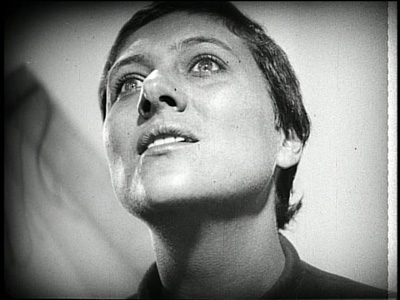

More important, and harder to capture in screenshots, is Dreyer's style. As Roger Ebert explains:
There is a language of shooting and editing that we subconsciously expect at the movies. We assume that if two people are talking, the cuts will make it seem that they are looking at one another. We assume that if a judge is questioning a defendant, the camera placement and editing will make it clear where they stand in relation to one another. If we see three people in a room, we expect to be able to say how they are arranged and which is closest to the camera. Almost all such visual cues are missing from "The Passion of Joan of Arc." Instead Dreyer cuts the film into a series of startling images.
This can hardly be stressed enough: There are no establishing shots. When two people talk to each other, you never get one of those over-the-shoulder shots and you rarely see the two people in the same frame. What instead you get is a highly rhythmic sequence of different, though related pictures, supported by Richard Einhorn's Voices of Light, which must be one of the greatest scores ever written for film.** The effect is hard to describe, and the best (not very good) comparison I can come up with is Battleship Potemkin. Maybe the fact that they don't do it like this anymore has to do with the fact that it's too easy to move the camera. Don't get me wrong: I like a good tracking shot more than the next man, and indeed Dreyer includes some to great effect, but he never moves the camera just because he can.

If I had to sum it up, I'd say it's like 2001 with faces instead of spaceships. (9)
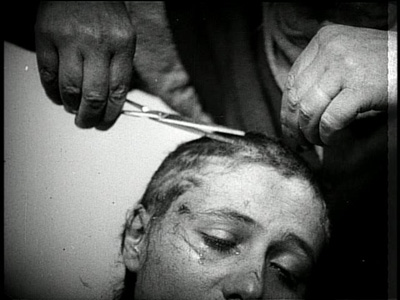
Not Natalie Portman

______
*Screenshots embedded from Matthw Dessem's essay on the film, which I strongly recommend for more insight than the present post delivers.

**Strictly speaking, Einhorn's composition is not a soundtrack written for, but rather an "opera/oratorio" "inspired by" the film. But given how well it fits the rhythm of the film, down to single cuts, it's a bit hard to believe this. My theory on this is that Einhorn wanted to compose a soundtrack for the film, but knew this wouldn't sit easily with authenticity fanatics who know that Dreyer disliked having his films accompanied by music, so he went down the "inspired by" route. This has the added advantage that pieces of "modern classical" music inspired by pretty much anything have a fair chance of actually being performed in concerts by orchestras, while soundracks don't. Pretty nifty!

05/01/2010

2009: Avatar (in 3-D)

The main thing most people are going to watch this for is the new 3-D technology and this works really well. I didn't find it as impressive as I thought I would (presumably because I've seen a lot of 3-D in the real world), but it looks realistic and is quite a bit of fun to behold.

Apart from that it is really not a good movie. Early on, we learn that the humans/Americans (often the same thing in this kind of movies) are on that planet because there's a precious resource to harvest (some stone). If in the process of getting it you have to kill some of the natives, so be it. But throwing bombs on their heads is maybe not the most clever way of making the natives voluntarily letting us harvest their planet, someone opines. Hmm, is it just me or is the screenwriter trying to make a comment on recent US foreign policy? (In general, the dialogues all sound like they were written by a fourteen-year-old boy, which may or may not be a deliberate choice by Cameron.)

The natives, however, aren't all that much like Afghans. Burqas? No, sir! Just think of the first five clichés that come to mind when I say "noble savage" and you know everything about them. They are so in touch with nature that while an animal the throat of which they've just slashed is bleeding to death, they inform it that its life-energy will be preserved. They keep a straight face, too. And their trees? They're not just trees; under the surface, all of their roots are interconnected and the memories of dead natives are stored there. (Regrettably, this is not referred to as the greenternet.) Cameron has really taken this whole Gaia idea in. And he lets it out!

But at least he has taken something in from the nonscreen world. A rare case. Almost all of the scenes seem second-hand. She at first wants to kill him and is furious when she is ordered to spend time with him. Hmmm, wonder whether they'll end up together? Like that. All of the time.

The screenplay also has structural problems, or, to put it differently, it doesn't have a single twist in it - you can predict the way the story will go after about ten minutes. Come to think of it, I thought that there would be a twist (concerning one specific character) that did not happen. On the other hand, between the two of us Heidi and I exactly predicted what would happen to the Sigourney Weaver character.

But let's not be picky about such things: Where the movie's really got to shine is the visuals. Well, I already mentioned the 3-D and the film's got some really nice shots of valleys, etc. But: The natives (and hence the avatars, which or who are designed to resemble them) look crap. So do the sort-of-horses. So do the sort-of-dinosaurs. In fact, every nonhuman animal in this film looks shite. (The plants look o.k.) What's worse: The film is basically set in two places; the military base and the forests. The military base is shot is shot in grey and blue. The forest is shot in green and blue. After half an hour I found myself longing for red, yellow and brown. And it's a long film.

I'm giving the movie 5/10 because the 3-D thing, as I may have mentioned, works really well. I strongly advise you, however, to see it in 2-D, irrespective of the size of the screen.

01/01/2010

2003: Elephant

Do US high schools really look that good? I've never been to one, but if movies are anything to go by - and I do realize there is a selection bias - they make a helluva setting for a film. Gus Van Sant, writer-director of Elephant would probably agree, given the tenderness with which his fictionalization of the Columbine massacres looks at its setting, really taking us inside the school in a manner which is not unlike that in which The Killing of a Chinese Bookie takes us inside a night club. Put more technically, lighting, use of focus, movement of camera and use of music are all excellent.

Regrettably, Van Sant does not care much for his characters - or rather, he didn't even bother to write any characters, giving us undistilled stereotypes instead: the athlete with his pretty-in-a-boring-way girlfriend, the artsy type, the ugly female outsider, yadda yadda. (Van Sant calls them "archetypes", but that doesn't make them any more interesting.) The killers, you'll be intrigued to learn, are outsiders; they like first-person shooters and watch documentaries about the Nazis.

Yeah, the "real artists" among the filmmakers all want to be auteurs, writing their own material. But Elephant makes a strong case that Van Sant should direct other people's scripts. David Ricardo had a point, after all. (6.5)

24/12/2009

1972: Aguirre, der Zorn Gottes (Aguirre, the Wrath of God)

Werner Herzog's widely acclaimed film about a 16th century expedition into the Southern American jungle looks like some hippie commune happened upon a bunch of costumes and a camera and decided to make a movie because "everybody can do it".

Klaus Kinski, in the title role, does his wild-eyed Kinski routine, overshadowing in the process the rest of the cast who seem to be on a mission to demonstrate that acting's actually hard.

The editing is poor. The results of the complete post-production sound overdub range from the o.k. to the ridiculous.

All aspects of the camerawork are done really badly. As for choices of frames and camera movement, nothing in particular seemed to motivate the former except for the desire to show the person that's speaking most of the time and the latter makes you remember that it's not easy to hold a camera still when you have one leg in the river, the other on an uneven stone and nothing to stabilize the camera. The lighting and colours? Well, you can see everything alright.

The complete absence of a narrative arc, the lack of motivation for some scenes (during one I got the impression that the actor was wondering when it would be over so he could finally scratch his arse) and the quality of the dialogues might lead the naive observer to believe that they just made the story up as they went along, but no:

Herzog wrote the screenplay "in a frenzy", and completed it in only two and a half days. Much of the script was written during a 200-mile (320 km) bus trip with Herzog's football team. During the bus trip, his teammates got drunk after winning a game and one of them subsequently vomited on several pages of Herzog's manuscript, which he immediately tossed out the window. Herzog claims he can't remember what he wrote on these pages.[3]

The screenplay was shot as written, with some minor differences.
When people say that something's "so bad that it's good", they usually mean that a work of art is unintentionally funny, and indeed I had to laugh when I watched some of the death scenes, which seem like reenactments of something out of The Simpsons. But what kept me watching was the fascination with the yawning gap between the film's renown and the real thing. Incredible. (2)