Showing posts with label 1920s. Show all posts

17/10/2010

1921: Manhatta

This silent ten-minute documentary, if you want to call it that, portrays a day in the life of Manhattan. Watching completely silent films (without music) is an experience I'm only getting used to, but it helps to look at the film as a series of animated photographs. "Moving pictures", you might say. (7.5)

08/10/2010

1920: The Neighbors

The best Keaton short I've seen so far, with lots of cool stunts. A bit like The General, only shorter and without trains. (7)

07/10/2010

1927: The Lodger

Though it is sometimes hailed as Hitchcock's first masterpiece, I was not that impressed by the story of a family who rents an apartment to a man who may or may not be the serial killer the whole town is looking for. Some interesting visuals at the beginning; apart from that it seems a little old, probably because it is. (6)

29/07/2010

1929: Blackmail (Sound Version)

Hitchcock's first talkie, about a homicide detective who investigates a murder he knows his girlfriend has commited and the man that blackmails them, is awkwardly structured and glacially paced, yet I found it reasonably entertaining. (6)

14/07/2010

1928: Spione (Spies) (Friedrich-Wilhelm-Murnau-Stiftung Restoration)

Lang's film about the state fighting a criminal mastermind that's not called Mabuse is a tad unfocused and long, yet overall a decent bit of entertainment. First appearance of a stache-twirling villain that I'm aware of. (6)

11/07/2010

1928: Oktyabr (Ten Days That Shook the World)

The Eisenstein film about the Russian Revolution, which I saw in a GDR version with German intertitles, Shostakovich's music and added sound effects, is interesting in that a certain interpretation of history affects the way the story is told at a very basic level: Unusually, here are practically no individual characters of relevance, which makes sense if you believe that there is no such thing as individuals, only classes with interests that fight each other. The film suffers from this, but makes up for it by being visually excellent. (7.5)

27/05/2010

1929: Chelovek s kino-apparatom (The Man with a Movie Camera)

Dziga Vertov's silent experimental/documentary film about life in The Modern Russian City attempts to cover all central aspects of life - work and play, birth and death - and time and again puts the filmmakers themselves into the frame, perhaps in an attempt to alert the audience to the subjective nature of the seemingly objective medium, perhaps out of vanity. Despite an undeniable stylishness of the whole movie and quite a feeling for rhythm in particular, the film could still be somewhat boring with the wrong music, I guess, but Michael Nyman's 2002 soundtrack is not only cool music in and by itself, but fits perfectly with the pictures. (7.5)

23/05/2010

1924: Paris qui dort (At 3:25)

René Clair's half-hour silent about a group of people who are the only ones awake and moving in a Paris that has otherwise come to a standstill is a mixture of the charming and the lengthy. (6)

22/05/2010

1922: Häxan

Benjamin Christensen's educational silent film which uses feature-type scenes to argue against the existence of witchs, witchcraft and the devil, isn't nearly as fucked up as I had hoped, though the writer-director in the role of the devil looks really very good. For stoners. (6)

13/05/2010

1921: The Kid

Crisp, funny, touching and featuring a great score (composed in 1971) as well as that certain something it's hard to put one's finger on, The Kid, about The Tramp's adventures with his cute adoptive son, may well be the quintessential Chaplin film. (8)

13/04/2010

1928: Steamboat Bill, jr.

Buster Keaton stars as the son of a steamboat captain in this loser-turned-hero story. The storm sequence is great, but it makes up only about a fourth of the film, and, let's face it, the rest is not that hot. (6.5)

07/04/2010

1920: Convict 13

Buster Keaton finds himself in a convict's uniform, and soon he's in a prison and about to be hanged. Rioting and lots of standard silent comedy jokes, in particular people falling down. Not the reason Keaton's famous. (5.5)

06/04/2010

1922: Daydreams

In this 22-minute fragment of a short, Buster Keaton writes home misleading letters to his sweetheart - when he writes about his success on Wall Street, it means he's actually cleaning it, etc. More than most old comedies this one suffers from its visual jokes having become not simply commonplace, but cliché. Reasonably entertaining nonetheless. (6)

13/02/2010

1928: La passion de Jeanne d'Arc (The Passion of Joan of Arc)

If you like courtroom dramas but are looking for one that's somewhat different, try The Passion of Joan of Arc. It even has a plot twist towards the end!

I'm joking, of course, Carl Theodor von Dreyer's picture is nothing like Anatomy of a Murder, but it is indeed a drama set in a courtroom, rather than the war movie/biopic you might expect on the basis of the title. Joan says she's the daughter of god, the church officials try to extract from her a confession that she did her deeds under the influence of Satan. Try to find some middle ground between those two! I like to think that Dreyer, a Dane, chose this topic to stick it to his compatriots, who were already as obsessed with compromise in the 1920s as they are today.

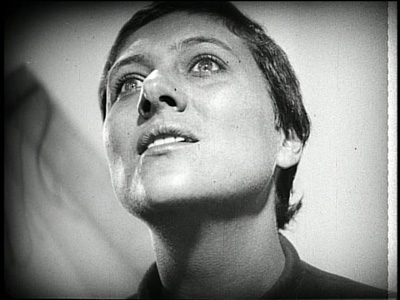
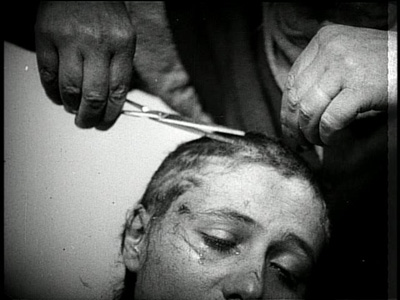
But The Passion is one of the films in which the plot isn't all that important; the picture is a visual experience more than most. First, there is the face of Maria Falconetti, who plays Joan*:


More important, and harder to capture in screenshots, is Dreyer's style. As Roger Ebert explains:
There is a language of shooting and editing that we subconsciously expect at the movies. We assume that if two people are talking, the cuts will make it seem that they are looking at one another. We assume that if a judge is questioning a defendant, the camera placement and editing will make it clear where they stand in relation to one another. If we see three people in a room, we expect to be able to say how they are arranged and which is closest to the camera. Almost all such visual cues are missing from "The Passion of Joan of Arc." Instead Dreyer cuts the film into a series of startling images.
This can hardly be stressed enough: There are no establishing shots. When two people talk to each other, you never get one of those over-the-shoulder shots and you rarely see the two people in the same frame. What instead you get is a highly rhythmic sequence of different, though related pictures, supported by Richard Einhorn's Voices of Light, which must be one of the greatest scores ever written for film.** The effect is hard to describe, and the best (not very good) comparison I can come up with is Battleship Potemkin. Maybe the fact that they don't do it like this anymore has to do with the fact that it's too easy to move the camera. Don't get me wrong: I like a good tracking shot more than the next man, and indeed Dreyer includes some to great effect, but he never moves the camera just because he can.

If I had to sum it up, I'd say it's like 2001 with faces instead of spaceships. (9)

Not Natalie Portman

______
*Screenshots embedded from Matthw Dessem's essay on the film, which I strongly recommend for more insight than the present post delivers.

**Strictly speaking, Einhorn's composition is not a soundtrack written for, but rather an "opera/oratorio" "inspired by" the film. But given how well it fits the rhythm of the film, down to single cuts, it's a bit hard to believe this. My theory on this is that Einhorn wanted to compose a soundtrack for the film, but knew this wouldn't sit easily with authenticity fanatics who know that Dreyer disliked having his films accompanied by music, so he went down the "inspired by" route. This has the added advantage that pieces of "modern classical" music inspired by pretty much anything have a fair chance of actually being performed in concerts by orchestras, while soundracks don't. Pretty nifty!

19/12/2009

1927: The General

It's an audacious idea to create a feature-length film consisting of two train chases with just a little plot padding and this focus on action can easily go wrong (cf. Kill Bill, Vol. 1). But Keaton and collaborators made it awe-inspiring and, at times, funny. Together with Sherlock jr. (the only other of his pictures I've seen), The General suggests that the famous comedian ought to be regarded as one of the great action movie directors. (8)

06/12/2009

1928: Un Chien Andalou

Seventeen minutes of well-photographed nonsense from Bunuel and Dali. Why not? (7) (Everybody always talks about the eye-slicing scene, but I like the doorbell much better.)