Four people meet in a room in Boulogne-sur-mer and their interconnected lives proceed from there. There's love and hate and the war in Africa and a lot of stuff I'm sure I didn't get on the first viewing. But, if that's a basis for that kind of opinion, it's not about the plot anyway, it's mostly about style. Muriel has a modernist soundtrack (think Stockhausen), shows lots of modernist architecture, both interior and exterior, and employs at least two ways of quick editing: First, a kind of proto-hip hop cutting, in which quick successions of cuts skip only a few minutes each; second, quick cuts away from the main plot to show small scenes that are not allowed to take any longer than they absolutely must (e.g., four seconds). That's a main technique for presenting a film not only about specific people, but also one about the city on the whole, as a kind of side order. Or is it the main order?
For the time being, I'm giving it eight points, but I think it's a grower.
Ah, splendid! The WW2 film about a rugged band of colourful characters on an all-important mission to destroy two of the Nazis' most powerful weapons on the greek island of Navarone is just what Hollywood blockbuster cinema is supposed to be: An epic featuring interesting locations, suspense, lots of silent-loud contrasts between the scenes and a cast of actors that are stars for a reason. (8)
When Inglourious Basterds came out, some people complained that it was not what they had expected from a film advertised as depicting the work of freedom fighters behind enemy lines: No training scenes, no raids on barracks, wtf? It is possible that Tarantino's deviations from the genre standards were inspired by L'armée des ombres, Jean-Pierre Melville's 1969 flop about the French resistance. Thinking back to the plot, it seems a strange movie indeed: Never do we see the freedom fighters take any effective action against the Germans, and one comes away from the film with the feeling that had the resistance never existed, this would not have made much of a difference. Instead, what is chronicled are the internal workings of the group; much time is given to the killing of resistance members who gave away the names of comrades. 145 minutes long, it is deliberately paced (many people will find this movie boring), and its subdued mood is underlined by Pierre L'Homme's excellent, excellent cinematography, which might best be described as a technicolor version of the work Robert Elswit did for Michael Clayton, and which nicely contrasts with Eric de Marsan's very good, somewhat saccharine music. A minor masterpiece which teaches the lesson that even if you're fighting on the side of the good guys, you may end up doing ugly things. (8)
Crisp, funny, touching and featuring a great score (composed in 1971) as well as that certain something it's hard to put one's finger on, The Kid, about The Tramp's adventures with his cute adoptive son, may well be the quintessential Chaplin film. (8)
Fellini's famous film, which I've finally seen, has not so much a plot as a series of scenes presenting the life of tabloid journalist Marcello Rubini and his estrangement from that life. Also portraying the life of the rich and famous in late 1950s/early 1960s Italy as vacuous in brilliant b/w pictures, La dolce vita may be seen as the more accessible, fun companion piece to Antonioni's"IncomunicabiliyTrilogy" and at almost three hours is not a minute too long. Just don't expect to see Anita Ekberg playing a major role. (8)
Though I realize it is set during Carnival, I still have a feeling that Rio in the late 1950s may not have been the magical place where everyone is always happy (except when throwing a mighty funk on jealousy grounds) and the samba is always playing (except when the bossa is playing). But who cares, it's not a documentary. As for the plot, Orfeu is set to marry Mina - but then Bambi-eyed Eurydice arrives from the countryside. O&E are soon getting it on, but Eurydice is being followed by someone who is either a bloke dressed up as death or Dr. D himself. Never mind the plot, though; the main actor here is the magical Rio described above, filmed in glorious Eastmancolor. (8)
Brian de Palma's film about a middle-aged man who meets a younger woman that is the spitting image of the man's late wife (who died in a car accident many years before) is often criticized as being merely derivative. But although de Palma's movie is clearly inspired by Hitchcock - he even got Bernard Herrman to compose the music - it tells a story that's quite distinct from the one in the 1958 masterpiece. Indeed one might argue that Vertigo's more important influence is stylistic, the beautiful score sometimes seeming to play endlessly to the painstaikingly composed frames depicting the man's, well, obsession with the young woman. An exercise in style that succeeds all the way. (8)
If you like courtroom dramas but are looking for one that's somewhat different, try The Passion of Joan of Arc. It even has a plot twist towards the end!
I'm joking, of course, Carl Theodor von Dreyer's picture is nothing like Anatomy of a Murder, but it is indeed a drama set in a courtroom, rather than the war movie/biopic you might expect on the basis of the title. Joan says she's the daughter of god, the church officials try to extract from her a confession that she did her deeds under the influence of Satan. Try to find some middle ground between those two! I like to think that Dreyer, a Dane, chose this topic to stick it to his compatriots, who were already as obsessed with compromise in the 1920s as they are today.
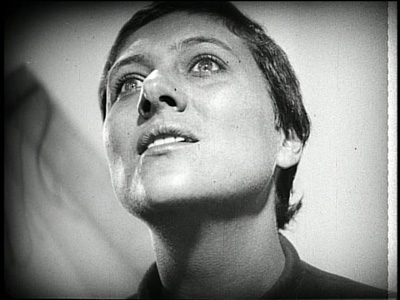
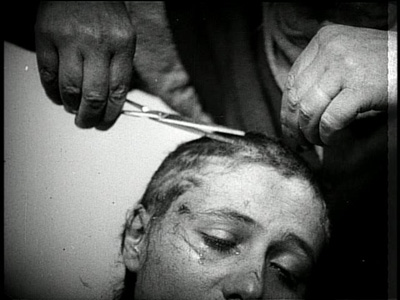
But The Passion is one of the films in which the plot isn't all that important; the picture is a visual experience more than most. First, there is the face of Maria Falconetti, who plays Joan*:
More important, and harder to capture in screenshots, is Dreyer's style. As Roger Ebert explains:
There is a language of shooting and editing that we subconsciously expect at the movies. We assume that if two people are talking, the cuts will make it seem that they are looking at one another. We assume that if a judge is questioning a defendant, the camera placement and editing will make it clear where they stand in relation to one another. If we see three people in a room, we expect to be able to say how they are arranged and which is closest to the camera. Almost all such visual cues are missing from "The Passion of Joan of Arc." Instead Dreyer cuts the film into a series of startling images.
This can hardly be stressed enough: There are no establishing shots. When two people talk to each other, you never get one of those over-the-shoulder shots and you rarely see the two people in the same frame. What instead you get is a highly rhythmic sequence of different, though related pictures, supported by Richard Einhorn's Voices of Light, which must be one of the greatest scores ever written for film.** The effect is hard to describe, and the best (not very good) comparison I can come up with is Battleship Potemkin. Maybe the fact that they don't do it like this anymore has to do with the fact that it's too easy to move the camera. Don't get me wrong: I like a good tracking shot more than the next man, and indeed Dreyer includes some to great effect, but he never moves the camera just because he can.
If I had to sum it up, I'd say it's like 2001 with faces instead of spaceships. (9)
Not Natalie Portman
______ *Screenshots embedded from Matthw Dessem's essay on the film, which I strongly recommend for more insight than the present post delivers.
**Strictly speaking, Einhorn's composition is not a soundtrack written for, but rather an "opera/oratorio" "inspired by" the film. But given how well it fits the rhythm of the film, down to single cuts, it's a bit hard to believe this. My theory on this is that Einhorn wanted to compose a soundtrack for the film, but knew this wouldn't sit easily with authenticity fanatics who know that Dreyer disliked having his films accompanied by music, so he went down the "inspired by" route. This has the added advantage that pieces of "modern classical" music inspired by pretty much anything have a fair chance of actually being performed in concerts by orchestras, while soundracks don't. Pretty nifty!
Directed by Fernando Meirelles and Kátia Lund; written by Bráulio Mantovani, based on a novel by Paulo Lins; cinematography by César Charlone 130 mins.; 1.85:1; colour; language: Portugese At Wikipedia, IMDb (8.8), Metacritic (79) Starting in the mid-1990s, world cinema has seen a series of films that achieve a thoroughly pop feel by employing techniques quite possibly inspired by music videos: A high frequency of cuts, hyperrealsitic colouring, quick camera movements and extensive, expressive use of pop music, to name but the most obvious elements. This school of directing has produced excellent pictures such as Requiem for a Dream, Lock, Stock and Two Smoking Barrels and Romeo+Juliet, but the textbook specimen - in the sense of most clearly exemplifying the style we're talking about - must be City of God.
Much in line with another trend in recent years, City of God is episodic, telling a number of related anecdotes. But this film, unlike Magnolia or Amores Perros, has a narrator as its center of gravity, our hero Buscapé, who lives in Rio de Janeiro's government-constructed slums the film's title refers to, where crime isn't a disruption of the normal course of life, but rather the normal course of life itself. Though that's where he lives, Buscapé himself quite clearly isn't cut out for crime, which makes him an insider-outsider and hence the ideal narrator for the film. And so we learn about drugs, revenge and the ever-prevailing need for honour and respect that fuels so much violence. While our hero finds - modest - success in the face of adversity, the narrative makes it quite clear that there is no development for the better in the City of God - nor for the worse, for that matter, things will just stay as fucked up as they have always been.
If that sounds like depressing viewing, it's not. The movie has been compared to Scorsese's Gangs of New York for the subject matter and Goodfellas for style, but it is more akin to the film that had a large hand in starting the wave of pop looking films, Danny Boyle's Trainspotting. As Trainspotting makes great entertainment out of heroin addiction, City of God allows you a look at the grimness of Brazilian slum life while keeping it a lot of fun. It's verging on the immoral, really.
Directed by Sofia Coppola; written by Sofia Coppola, based on the novel by Jeffrey Eugenides; cinematography by Edward Lachman 97 mins.; 1.85:1; colour; language: English At Wikipedia, IMDb (7.2), Metacritic (76)
A group of men remember the events that transformed their lives forever, and not for the better: Back in their youths, in a 1970s US suburb, there were five unattainable girls, and they killed themselves.
The film starts with a suicide attempt by the youngest one, Celia, and once she succeeds, the girls' parents isolate their daughters even more than they had before. Later, after the girls have broken a curfew, they'll take them out of school. The unattainability, of course, only heightens the boys' fascination with them. And that's what the film is about: Despite the film's title (identical to that of Jeffrey Eugenides' novel it's based on), the film is not so much about the five sisters but about the boys' fascination with them, or, to be more precise: their memories of their fascination with them. "Some readers (in my experience they were mostly women) were frustrated with Eugenides' book for the way it fixated on the men's view of the women instead of the women themselves," writes Stephanie Zacharek. The film does not change this focus. Complaining about it is a little like complaining that Einstein made no contributions to the theory of evolution. The 95% of the film that are set in the 1970s should be seen not as a depiction of reality, I think, but rather as a depiction of rememberance.
That interpretation is certainly fueled by the film's atmosphere: Drenched in pastel and accompanied by the ambient music of brilliantly chosen collaborators Air, the movie's positively dream-like, seeming at times to be set underwater. I've seen a thousand pictures set in American suburbs, but none of them made them look like a world apart. This one does.
In the film's most impressive sequence, we learn that one of the young men finally attains what he desires, and that it fucks up his life forever. Take heed, o young ones!
Directed by Sean Penn; written by Jerzy Kromolowski, based on a book by Friedrich Dürrenmatt; cinematography by Chris Menges 124 mins.; 2.35:1; colour; language: English At Wikipedia, IMDb (6.9), Metacritic (71)
Jerry Black, a homicide detective is about to retire as the mutilated body of a young girl is found. He is the one who tells the dead girls parents the bad news and her mother makes him swear to find the killer. Soon a suspect is arrested, a mentally retarded man who sort of admits to the murder before killing himself. Jerry doesn't believe the dead man was the killer, but is told in decreasingly uncertain terms that he is now retired and the case is closed. He (a) lets it go and spends the rest of his days gardening or (b) can't forget the pledge he made and tries to find the real killer? Come on, make a guess!
The film's plot has a somewhat winding history: The screenplay for the 1958 German mystery Es geschah am hellichten Tag (recommended!) was written by Swiss author Friedrich Dürrenmatt. However, he thought that the story was too obedient to the conventions of the genre and reworked it into a novella with the telling title Das Versprechen: Requiem auf den Kriminalroman, adequately translated into English as The Pledge: Requiem for the Detective Novel. Which is the source for this film.
It's a bit hard to explain why this film is great. For one, it doesn't have any weaknesses one might point out, which you can't say about most films. It also has the finest Jack Nicholson performance I've ever seen, and I've seen quite a few. But maybe the key lies in the trailer?
Like no other trailer before it, the clip tries to make it look (and sound!) as though the film becomes all fast and shocking and dramatic towards the end. I think even if you haven't seen the film but look at the trailer really closely, you can see it's a pretty desperate effort: He's taking a gun! He's talking to someone! The truth is that the ending of the film isn't like that at all. Slowly and painfully it grinds to an end. In that it is violating the rules of its genre more clearly than Dürrenmatt's novella ever did.
That may still not make it sound like a great movie, but that's the best I can come up with. Alternatively, maybe all the people who thought it was so-so are right. But I doubt it.
As young ballet dancer Vicky makes a brilliant carreer for herself, she attracts the interest of both ballet company director Lermontov and composer Julian. Conflict ahead! - Really, the melodramatic story of this film isn't much to speak of; the movie thrives, however, on the cinematography by Jack Cardiff, using three-strip technicolor and making this one of the best-looking colour films in the history of cinema. (If you don't want to take my word for it, take Martin Scorcese's word for it.) And the dance scene in the middle belongs in the museum of great movie sequences. I'm saying that as someone who usually has no time whatsoever for ballet. (8)
Directed by Steven Soderbergh; written by Ted Griffin, based on a screenplay by Harry Brown and Charles Lederer; cinematography by Steven Soderbergh 116 mins.; 2.35:1; colour; language: English At Wikipedia, IMDb (7.6), Metacritic (74)
As suggested by the distribution of Metacritic and IMDb scores, there seems to be some general agreement that this is a good-but-not-great movie, nothing but director Steve Soderbergh clearing his throat before producing another one of his Great Masterpieces of American Cinema. Fuck it, I say. Give me this over Solaris or The Good German any day.
The setup is simple enough: Just out of prison, Daniel Ocean (Clooney) seeks out his old chum Rusty Ryan (Pitt) to suggest they rob what is repeatedly described as the world's safest vault, one holding cash for three Las Vegas casinos. As coincidences go, they are owned by the man who is now with Ocean's ex-wife Tess (Roberts), Terry Benedict (Garcia) - the latter exhibiting a hefty dose of arrogance and the mediterranean looks that pale Englishmen, distgust written all over their faces, sometimes describe as "Italian waiter". ("He is good-looking in a gloriously smarmy, Italian-waiter fashion," wrote a Times journalist when trying to explain why he and fellow English football fans dislike Cristiano Ronaldo.)
And so the fun begins. The film goes through all the standard elements of heist movies, driven forward by a tight screenplay and a score that is truly in the service of the picture (David Holmes). It also capitalizes on the screeen presences and comedy talents of the leading men Clooney and Pitt, with the likes of Matt Damon and Don Cheadle serving as glorified extras. At times it comes across as a toned-down screwball comedy: Roger Ebert recalls "the conversation involving Clooney, Roberts and Garcia, when the casino boss finds the ex-husband at Tess' table in the dining room. The two men of course despise one another, but are so smooth and cool we note it only in the precision of their timing and word choices, leading up to a final exchange in which Danny, leaving the table, says 'Terry' in a way that uses the first name with inappropriate familiarity, and Terry responds 'Danny' on precisely the same note." But the film's most prominent feature is certainly its lushness, almost every frame packed with bling, blong and blang. You can see Ocean's Eleven as a kind of anti-Reservoir Dogs, and the two would make a great double feature.
The film really made me appreciate the arts of screenwriting and directing. Director-cinematographer Soderbergh composes every frame meticulously, and the screenplay by Ted Griffin suggests to the first-time viewer she knows exactly what is going on, only to reveal at the end that she's been led astray - and I'm not talking about someone waking up and realizing it was only a dream.
It's easy enough to miss that when you see it for the first time. It's just too much fun.
Directed by Patrice Chéreau; written by Anne-Louise Trividic and Patrice Chéreau, based on stories by Hanif Kureishi; cinematography by Eric Gautier 119 mins.; 2.35:1; colour; language: English At Wikipedia, IMDb (6.3), Metacritic (69) Imagine a world in which films didn't show people eating. You could show them talking about eating or trying to get food, you could show them getting ready for eating or munching after they'd bitten off a piece, but never, ever, were you allowed to show food entering the mouth. (If you wanted to show people while in the act of eating, you'd have to show them from behind or only shoot them from the neck down.) Sure, there'd be specialised eating pictures, but not only would those be strictly for adults, but they'd never been shown in regular cinemas. Many would point out that these pictures are only for you if you find watching people eating interesting because in terms of witty dialogue, gripping plot developments or interesting camera work they'd have next to nothing on offer. As far as characterization is concerned, well, everybody in those movies would really be into eating, all of the time.
That, of course, is what we have today with regards to sex. So when director Patrice Chéreau decided to include in Intimacy about four seconds' worth of shots of an erect penis, in one case entering a woman's mouth, it was a talking point at least in this country, giving the film free extra PR (not that that helped an awful lot).
But the way the film shows sexuality does not come across as a PR stunt at all. The sex scenes, which are far from erotic, fit seamlessly into the aesthetics of the film, which just seems to passively observe. It's natural that we'll see an erection here and there as sex is at the centre of the story: Jay and Claire meet each Wednesday in Jay's rundown London apartement - a shithole, really - and fuck. When they're done, she leaves. They keep conversation to a minimum. They don't know each other's names. But Jay gets curious and follows Claire after she leaves. This leads him into the basement of a pub where Claire and her amateur troupe perform The Glass Menagerie. Back upstairs, Jay strikes up a conversation with Andy, a pub regular. If Jay were played by Michael Douglas, you could see where this is going, but he's not.
The seemingly detached was the scenes are filmed goes along with a script that doesn't explain an awful lot. How did Jay and Claire meet? We never learn. We get a few flashbacks into Jay's past, but they're not particularly helpful, only showing us he used to be happier. This is the kind of thing that drives critics into creativity: Roger Ebert develops a theory on why Jay hates women, but, unless I've missed something, it is never established that he does. Edward Guthman informs us: "'Intimacy' tells the story of two people wishing to escape themselves and the burden of their memories through the purge of sex." Maybe.
And that's where the film leaves you: Without any answers, on the most anonymous, loveless London streets I've ever seen depicted in a film. And by that I don't mean it was shot in Tottenham.
***
The trailer, being a trailer, makes it look a little too dramatic:
#9, due on Wednesday, will be a star-studded, feelgood blockbuster. Promise!
Alain Resnais' follow-up to the magnificent Hiroshima mon amour is set in a castle now functioning as a hotel: a man is telling a woman about what they did when they met last year, while she keeps telling him she doesn't remember. Situated on the line between conventional narrative cinema and the pure surrealism of films like L'age d'or and possibly the best-photographed b/w film I've ever seen, the picture seems to be aimed not so much at being understood intellectually as at putting the audience in a trance-like state. Alternatively, you might dismiss it as pretentious artsy-fartsy crap (AFM 5!).
Is it going too far to say that in his less accessible films David Lynch did nothing but take Marienbad, add violence and put American pop culture references where Resnais' film uses European high culture? Yes, probably. (8.5)
(How to win the game in the film explained in German and French)
Otilia (major screen presence Anamaria Marinca) helps her friend Găbiţa get an abortion - which in communist Romania is illegal. Yes, it's the feelgood film of the noughties, and you can trust writer-director Christian Mungiu to milk the setup for all its dramatic potential. Truly gripping, although I think that a Metacritic score of 97 may be taking things a bit far. (8)
Is this even a film? Well, it's a 27-minute sequence of nonmoving b/w pictures with an omniscient narrator's voiceover and a little classical music, dealing with a man that, after the nuclear war is over, is a prisoner in a POW camp and is sent back and forth in time by the Germans, who finally managed to win a world war.
Though a critic's favourite, today La jetée is probably best known as the film that inspired 12 Monkeys. Both films are about equally good (8) and would make a nice double feature.
It's an audacious idea to create a feature-length film consisting of two train chases with just a little plot padding and this focus on action can easily go wrong (cf. Kill Bill, Vol. 1). But Keaton and collaborators made it awe-inspiring and, at times, funny. Together with Sherlock jr. (the only other of his pictures I've seen), The General suggests that the famous comedian ought to be regarded as one of the great action movie directors. (8)
Now, that's how to open a film: A close-up of a good-looking woman breathing "Je t'aime. Je t'aime" into a receiver. The French, eh?
Louis Malle's first film, set during a weekend in a late-50s Paris that the director deliberately made look modern is a crime gone wrong story. There's Julien Tavernier, the employee of a arms manufacturer who kills his boss, who is also his lover's husband; the lover, Florence Cavala, who is looking for Tavernier after he got stuck in an elevator on his way from the crime scene; and a young couple who steal his car and get into trouble of their own. As was remarked in the Washington Post (according to my DVD cover), the film's most important character may be Paris at night, the stylish photography accompanied by Miles Davies' trumpet. Despite minor weaknesses, this is a very good film (8).
 Four people meet in a room in Boulogne-sur-mer and their interconnected lives proceed from there. There's love and hate and the war in Africa and a lot of stuff I'm sure I didn't get on the first viewing. But, if that's a basis for that kind of opinion, it's not about the plot anyway, it's mostly about style. Muriel has a modernist soundtrack (think Stockhausen), shows lots of modernist architecture, both interior and exterior, and employs at least two ways of quick editing: First, a kind of proto-hip hop cutting, in which quick successions of cuts skip only a few minutes each; second, quick cuts away from the main plot to show small scenes that are not allowed to take any longer than they absolutely must (e.g., four seconds). That's a main technique for presenting a film not only about specific people, but also one about the city on the whole, as a kind of side order. Or is it the main order?