If you like courtroom dramas but are looking for one that's somewhat different, try
The Passion of Joan of Arc. It even has a plot twist towards the end!
I'm joking, of course, Carl Theodor von Dreyer's picture is nothing like
Anatomy of a Murder, but it is indeed a drama set in a courtroom, rather than the war movie/biopic you might expect on the basis of the title. Joan says she's the daughter of god, the church officials try to extract from her a confession that she did her deeds under the influence of Satan. Try to find some middle ground between
those two! I like to think that Dreyer, a Dane, chose this topic to stick it to his compatriots, who were already as obsessed with compromise in the 1920s as they are today.
But
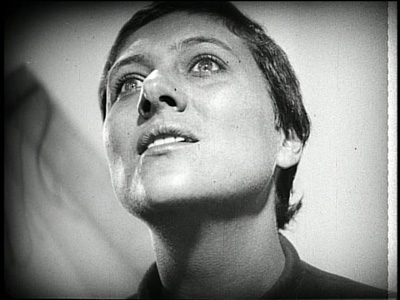
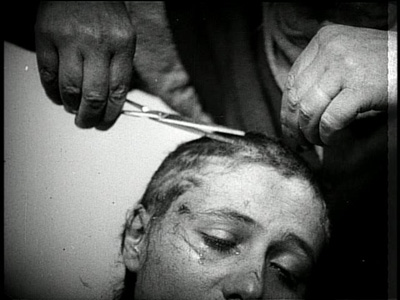
The Passion is one of the films in which the plot isn't all that important; the picture is a visual experience more than most. First, there is the face of Maria Falconetti, who plays Joan*:

More important, and harder to capture in screenshots, is Dreyer's style. As Roger Ebert
explains:
There is a language of shooting and editing that we subconsciously expect at the movies. We assume that if two people are talking, the cuts will make it seem that they are looking at one another. We assume that if a judge is questioning a defendant, the camera placement and editing will make it clear where they stand in relation to one another. If we see three people in a room, we expect to be able to say how they are arranged and which is closest to the camera. Almost all such visual cues are missing from "The Passion of Joan of Arc." Instead Dreyer cuts the film into a series of startling images.
This can hardly be stressed enough: There are no establishing shots. When two people talk to each other, you never get one of those over-the-shoulder shots and you rarely see the two people in the same frame. What instead you get is a highly rhythmic sequence of different, though related pictures, supported by Richard Einhorn's
Voices of Light, which must be one of the greatest scores ever written for film.** The effect is hard to describe, and the best (not very good) comparison I can come up with is
Battleship Potemkin. Maybe the fact that they don't do it like this anymore has to do with the fact that it's too easy to move the camera. Don't get me wrong: I like a good tracking shot more than the next man, and indeed Dreyer includes some to great effect, but he never moves the camera just because he can.
If I had to sum it up, I'd say it's like
2001 with faces instead of spaceships. (9)
 Not Natalie Portman______
*Screenshots embedded from Matthw Dessem's essay on the film, which I strongly recommend for more insight than the present post delivers.
**Strictly speaking, Einhorn's composition is not a soundtrack written for, but rather an "opera/oratorio" "inspired by" the film. But given how well it fits the rhythm of the film, down to single cuts, it's a bit hard to believe this. My theory on this is that Einhorn wanted to compose a soundtrack for the film, but knew this wouldn't sit easily with authenticity fanatics who know that Dreyer disliked having his films accompanied by music, so he went down the "inspired by" route. This has the added advantage that pieces of "modern classical" music inspired by pretty much anything have a fair chance of actually being performed in concerts by orchestras, while soundracks don't. Pretty nifty!


 Not Natalie Portman


